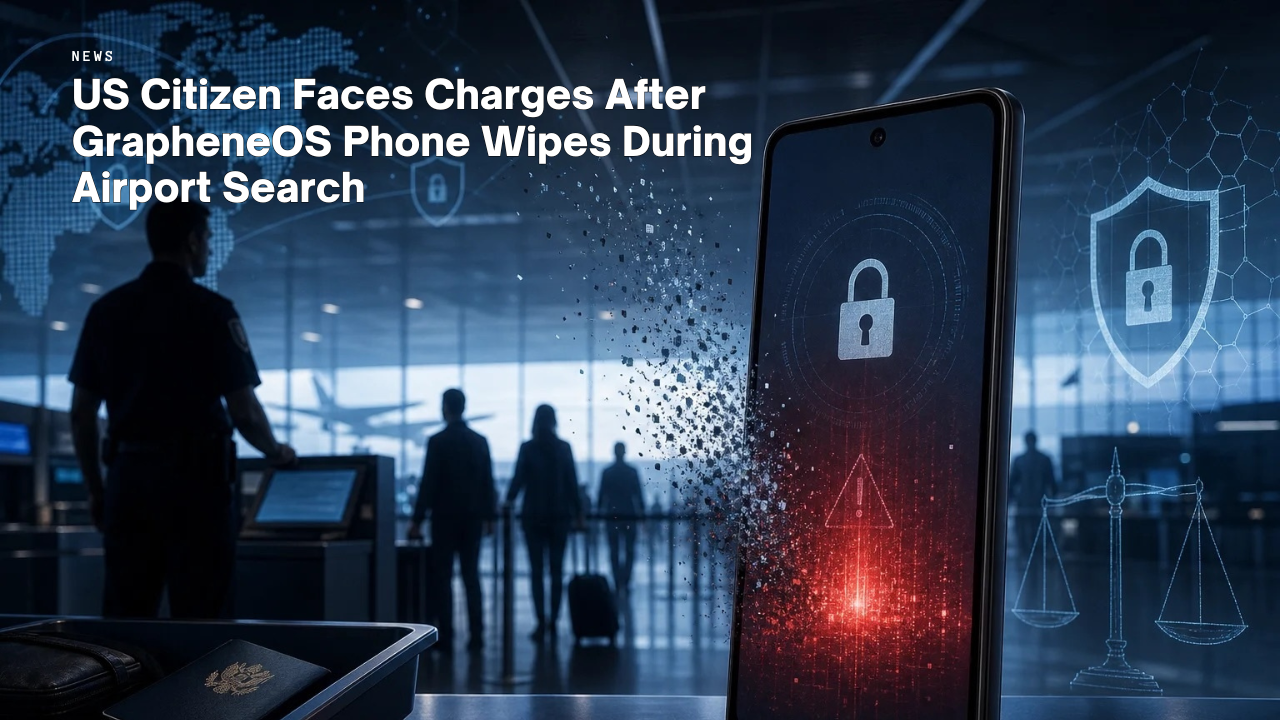
A 37-year-old Atlanta resident is currently facing federal charges after his GrapheneOS-equipped smartphone reportedly wiped all its data during a secondary customs inspection at an international airport. According to records from the U.S. District Court for the Northern District of Georgia, federal prosecutors have charged the man with “alteration, destruction, or concealment of records” in relation to a federal investigation.
The case has sent ripples through the cybersecurity and digital rights communities in 2026, as it highlights the growing friction between personal privacy tools and the sweeping search authorities granted to U.S. Customs and Border Protection (CBP) at ports of entry. For many tech-savvy travelers, using an operating system like GrapheneOS is about protecting sensitive data from hackers, but for law enforcement, a phone wipe during an active search can look like a criminal attempt to hide evidence.
Key Takeaways
- The Incident: A US citizen was charged after his GrapheneOS phone triggered a factory reset while being inspected by CBP officers at Atlanta’s Hartsfield-Jackson International Airport.
- Privacy vs. Law: While tools like GrapheneOS are legal and designed for high security, using “auto-wipe” features during a government search may lead to obstruction of justice charges.
- Border Search Authority: CBP generally does not need a warrant to search electronic devices at the border, a legal reality that often surprises travelers.
- Legal Precedent: This case could set a significant precedent for how technology law interprets automated security features in a criminal context.
Look, we live in an era where our entire lives reside on our smartphones. From banking details to private messages, the volume of sensitive information we carry is staggering. It is no wonder that privacy-conscious individuals are turning to hardened operating systems. However, as this Atlanta case demonstrates, the very features designed to keep your data safe can sometimes become a legal liability if they activate at the wrong moment.
What is GrapheneOS and why is it at the center of this case?
GrapheneOS is a privacy and security-focused mobile operating system that is compatible with Google Pixel phones. It is an open-source project that strips away Google services and implements advanced “sandboxing” and memory safety features. One of its most notable capabilities is the “auto-reboot” or “panic” feature, which can be configured to wipe the device or lock it down if certain conditions are met, such as an incorrect PIN entry or a specific period of inactivity.
In the case of the US citizen charged in Atlanta, prosecutors allege that the device wiped its contents while in the possession of federal agents. The defendant, who was returning from an international trip, was reportedly flagged for a secondary search. According to the criminal complaint, the device reset to factory settings during the inspection, rendering the data unrecoverable for the investigators. The core of the legal battle now rests on whether this was a deliberate act of destruction or an automated security protocol the user didn’t manually trigger in that moment.
If you are interested in how other mobile technologies are evolving to handle data and security, you might want to check out our review of the Galaxy Z Fold8 Ultra Fold8 and Flip8, which look at the latest hardware security features from mainstream manufacturers.
Is using GrapheneOS illegal in the United States?
No, using GrapheneOS is perfectly legal. It is a legitimate tool used by journalists, activists, and security professionals to protect their digital rights. The issue in this specific case isn’t the software itself, but the phone wipe event that occurred during a government search. Under 18 U.S. Code § 1519, it is a crime to destroy or alter records with the intent to impede or obstruct a federal investigation. The prosecution must prove that the defendant had the “intent” to destroy evidence, which is the high hurdle in cases involving automated privacy software.
How does an airport search impact your digital rights?
When you stand at a U.S. border or airport, your fourth amendment rights, which typically protect you against “unreasonable searches and seizures”, are significantly narrowed. This is known as the “Border Search Exception.” The Supreme Court has historically held that the government’s interest in protecting the border outweighs an individual’s privacy interest. This means CBP officers can generally search your luggage and your electronic devices without a warrant.
A report by TechSpot details that federal agents often use specialized forensic tools to “dump” the data from a traveler’s phone. If the phone is locked, they may ask for the passcode. While travelers can refuse to provide a passcode, the consequences can include the seizure of the device for an indefinite period or, for non-citizens, the denial of entry. For a US citizen, refusing to unlock a phone is a legal right, but if the phone suddenly wipes itself, the situation moves from a “refusal to cooperate” to a “destruction of evidence” allegation.
The critical question for technology law in 2026 is whether a user can be held criminally responsible for an automated security feature they enabled long before the search occurred.
The Legal Charges: Destruction of Records and Obstruction
The specific charge of “alteration, destruction, or concealment of records” is a heavy one. It carries a potential prison sentence of up to 20 years. In this case, the government argues that by having a device that wipes itself, the defendant effectively destroyed evidence relevant to an ongoing investigation. This creates a terrifying “catch-22” for privacy advocates: if you secure your phone too well, are you automatically obstructing justice?
We’ve seen similar tensions in the past with “disappearing messages” on apps like Signal or WhatsApp. However, a full-scale phone wipe at the border is a much more dramatic event. The defense will likely argue that the wipe was a “standard security feature” and that the defendant did not take an active, contemporaneous step to delete data while the officers were watching. Whether a judge agrees that “pre-set” automation constitutes “intent” will be the defining factor of this trial.
Best Practices for Privacy When Traveling in 2026
If you are traveling with sensitive data, it is essential to understand the landscape of technology law and how to protect yourself without ending up in a courtroom. Many experts suggest not traveling with your primary device at all if you have high-security concerns. Instead, use a “burner” device with minimal data or a fresh factory-reset phone, and access your data via secure cloud storage once you have cleared customs.
- Back up everything: Before you head to the airport, ensure your device is backed up to a secure, encrypted cloud service or a physical drive left at home.
- Know your auto-wipe settings: If you use GrapheneOS or similar hardened systems, be aware of what triggers a wipe. Is it 10 failed PIN attempts? Is it a “panic” button?
- Be honest but firm: You do not have to provide your password, but lying to a federal officer is a separate crime.
- Consult a lawyer: If you are frequently carrying sensitive professional data (e.g., as a lawyer or medical professional), have a legal plan in place.
While we often discuss the Latest Tech Products Released for their convenience and style, this case serves as a sober reminder that the “power” of our gadgets comes with significant responsibility. The legal system is often several years behind the technological curve, and travelers are currently the ones stuck in that gap.
The Role of GrapheneOS in Modern Privacy
GrapheneOS has gained popularity precisely because people are tired of the data collection practices of major tech corporations. It offers a level of privacy that stock Android or iOS simply cannot match. For the user in Atlanta, the choice of OS was likely a proactive step toward digital autonomy. It is unfortunate that this step is now being framed as a move of criminal desperation.
The developer community behind GrapheneOS has consistently argued that their software is designed to protect users from “non-consensual” access to data. This includes protection against theft, loss, and unauthorized forensic searches. The US citizen involved in this case is currently out on bond, but the proceedings will likely drag on for months as both sides debate the mechanics of the phone wipe.
Can the government force you to unlock your phone?
The short answer is: it depends. Under current technology law, the Fifth Amendment protects you from being forced to provide “testimonial” evidence, which includes your passcode (something you know). However, some courts have ruled that biometrics (something you are), like your fingerprint or FaceID, are not testimonial and can be compelled. This is why many privacy advocates recommend disabling biometrics and using a strong alphanumeric password before arriving at an airport search area.
If you are looking for other ways to improve your daily digital life while keeping things secure, check out our guide on the Best Smart Scales for At Home Health Tracking, which often involves sensitive personal health data that requires similar privacy considerations.
Sources
- TechSpot, US Citizen Faces Charges After GrapheneOS Phone Wipes
- CBP.gov, Border Search Authority and Electronic Devices
- GrapheneOS, Official Technical Specifications and Security Features
Frequently Asked Questions About Phone Wipes at the Border
Can CBP arrest me for a phone wipe?
Yes, if federal prosecutors believe the phone wipe was a deliberate attempt to destroy evidence during an investigation, they can charge you with obstruction of justice or destruction of records. This is exactly what happened in the Atlanta case involving the US citizen. While a wipe might be automated, the government can argue your intent was established when you enabled the feature.
What happens to my phone if I refuse a search?
If you refuse to unlock your phone during an airport search, CBP has the authority to seize the device. They may keep it for several days or even weeks to attempt a forensic bypass. For US citizens, you will usually be allowed to enter the country, but your device will stay behind. For foreign nationals, refusal can result in being turned away at the border.
Is GrapheneOS safe for regular travelers?
GrapheneOS is extremely safe from a cybersecurity perspective. However, from a legal charges perspective, travelers should be careful with auto-wipe or “duress” features. If a device resets while in an officer’s hand, it creates a high risk of being accused of a crime. It may be better to disable “wipe on failed attempts” before passing through customs.
Are my digital rights different at the airport?
Yes. The U.S. government operates under the “Border Search Exception,” which grants them broad authority to search persons and property without a warrant or “probable cause.” Your digital rights are more limited at a port of entry than they are on a standard street corner in the middle of a city.
What did the Atlanta man specifically do wrong?
According to the prosecution, the man’s GrapheneOS phone underwent a factory reset during the inspection. The government alleges this was a criminal act of hiding records. The defense will likely argue it was an automated software response to the forensic tools the agents were using, rather than a manual action by the defendant.
The outcome of this case will likely define the boundaries of technology law for years to come. As 2026 progresses, we expect to see more clarity on how “security by design” interacts with “obstruction of justice.” For now, the best advice is to be incredibly mindful of your device settings before you step off that plane. Your privacy is a right, but exercising it in a way that triggers a phone wipe during an airport search can lead to a legal nightmare you never intended.

TRENDING: Galaxy Z Fold8 Ultra Fold8 and Flip8 Reviewed
Download the new game Guess The Celebrity Quiz and check how well you know your idols
Always be up to date with the news and follow the trends!
 Support our work by giving us a small donation
 Support our work by giving us a