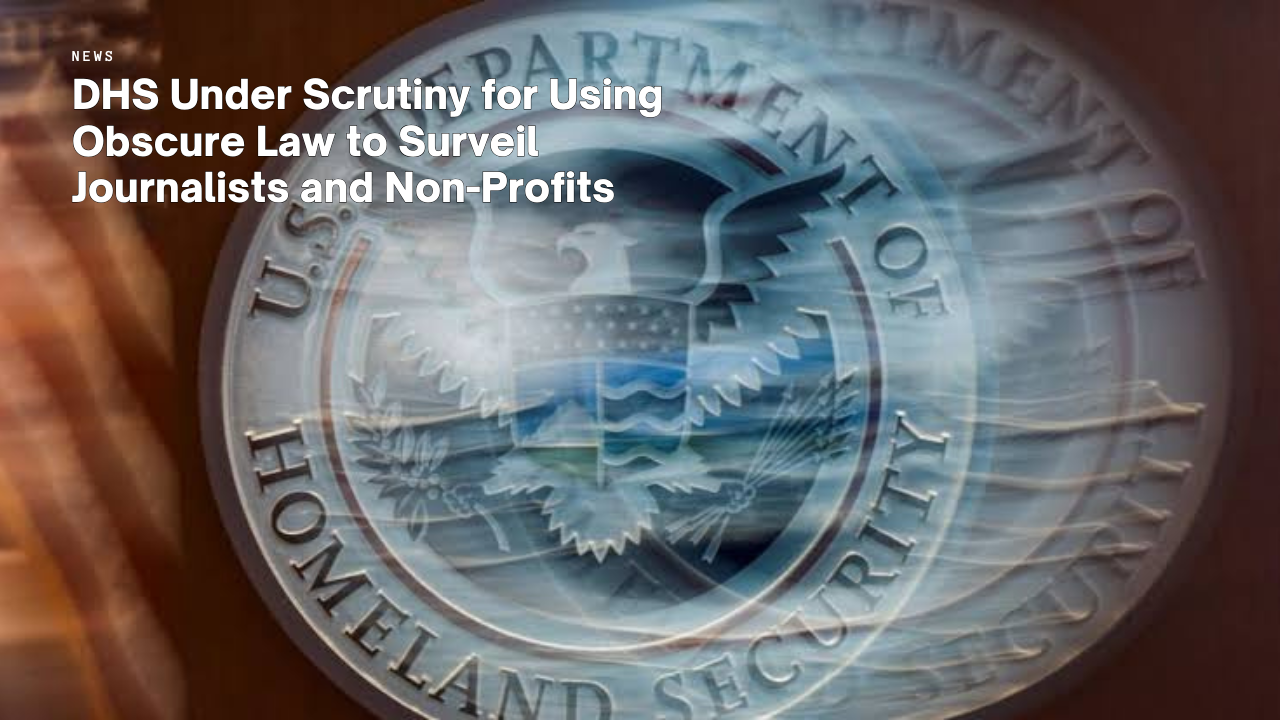
The Department of Homeland Security (DHS) is facing intense public and legal scrutiny after reports surfaced that it has been using an obscure 1950s-era customs law to compel travel companies and financial institutions to hand over private records belonging to journalists, non-profit organizers, and labor unions. This practice, involving the issuance of “1509 summons,” has bypassed traditional judicial oversight, sparking a fierce debate over the erosion of civil liberties and the limits of government surveillance in 2026.
- DHS is using “1509 summons” to collect private data without a warrant or judge’s approval.
- Targets include investigative journalists, human rights non-profits, and labor union leaders.
- Civil liberties groups argue this is a “backdoor” surveillance method that violates the First and Fourth Amendments.
- The obscure law was originally intended for customs and duty investigations, not domestic surveillance.
Table of Contents
- What is a 1509 Summons and how is DHS using it?
- Why journalists and non-profits are being targeted
- The legal implications for civil liberties and privacy
- Government justification versus public transparency
- Steps for organizations to protect their data
What is a 1509 Summons and how is DHS using it?
A 1509 summons is a specific legal tool granted under the Tariff Act of 1930, allowing customs officials to demand records related to the importation of merchandise. In practice, this means the government can request documents from third parties, such as airlines or banks, to ensure duties are being paid correctly. However, a recent investigation published by The Guardian revealed that DHS has repurposed this tool to gather intelligence on individuals who have no clear connection to trade or customs violations.
Unlike a search warrant, a 1509 summons does not require a judge’s signature. It is issued administratively by DHS officials, meaning there is no independent check on whether the request is reasonable or lawful. We often see these “administrative subpoenas” in specific regulatory contexts, but their application to domestic activists and reporters represents a significant expansion of executive power. By using this obscure law, DHS effectively bypasses the Fourth Amendment’s protection against unreasonable searches and seizures.
Think about it this way: if the government wanted to search your home, they would need to prove “probable cause” to a neutral judge. But by framing the request as a customs inquiry, DHS can skip that step and go straight to the company holding your data. This is particularly concerning because the recipients of these summons, often large corporations, rarely have the incentive or the legal standing to fight the request on your behalf.
Why journalists and non-profits are being targeted
The list of targets identified in recent disclosures is striking. It includes journalists who have covered border issues, non-profits providing humanitarian aid to migrants, and even labor unions involved in political organizing. According to documents obtained through the Freedom of Information Act, DHS used these summons to track travel patterns, hotel stays, and financial transactions of individuals who were deemed “persons of interest” by the agency.
But why these groups specifically? Journalists are often the first to expose government overreach, and non-profits often fill the gaps where government policy fails. By surveilling these individuals, the government gains a window into their sources, their movements, and their funding. This creates a “chilling effect” where people become afraid to speak out or organize for fear of being placed on a government watch list. We have seen similar concerns raised in our coverage of US citizens facing charges after phone wipes at the border, highlighting a broader trend of aggressive digital searches.
The targeting of labor unions is also a new and concerning development. Unions represent a significant political force, and monitoring their leadership’s travel and meetings could provide the government with sensitive strategic information. It is not just about catching “bad actors”; it is about collecting a database of dissent. The obscurity of the 1509 law makes it the perfect vehicle for this type of quiet, persistent surveillance.
The legal implications for civil liberties and privacy
Is the use of 1509 summons constitutional?
This is the question at the heart of the current controversy. Civil liberties advocates, including the American Civil Liberties Union (ACLU), argue that using customs laws to investigate political activity is a blatant violation of the First Amendment. If the government can monitor who a journalist meets with or where a non-profit worker travels, the freedom of the press and the right to associate are effectively neutralized. Legal experts warn that the lack of judicial oversight makes the 1509 summons a dangerous tool for political retribution.
From a privacy perspective, the situation is even more dire. Most people assume that their travel history and financial records are private unless they are suspected of a serious crime. The use of administrative summons breaks that social contract. It allows the DHS to cast a wide net, collecting data on hundreds of people in the hopes of finding one useful piece of information. This “fishing expedition” style of policing is exactly what the founders sought to prevent when they wrote the Bill of Rights.
Furthermore, the data collected through these summons often ends up in massive government databases that are shared across agencies. Once your information is in the system, it is nearly impossible to get it out. This long-term storage of data on law-abiding citizens is a cornerstone of modern surveillance states, and its presence in the U.S. is a major red flag for privacy advocates in 2026.
Government justification versus public transparency
DHS has defended its use of the 1509 summons, stating that it is a necessary tool for maintaining border security and national safety. The agency argues that the law provides the flexibility needed to act quickly in a fast-paced environment. However, they have been less forthcoming about why this specific tool is being applied to people who have no obvious connection to smuggling or trade fraud. The lack of transparency is perhaps the most frustrating part for those caught in the crosshairs.
Actually, the government’s own guidelines suggest that administrative summons should be used sparingly and only when other, more transparent methods are unavailable. The fact that DHS has leaned so heavily on an obscure provision suggests a deliberate attempt to avoid public and legal scrutiny. When agencies operate in the shadows, accountability suffers. This is a recurring theme we see in modern governance, much like the international calls for AI safety regulations to prevent algorithmic bias and surveillance.
One counterintuitive take is that by overusing these summons, DHS might actually be making the country less safe. By flooding their own systems with data on journalists and activists, they are creating more “noise” that makes it harder to find actual threats. It is a classic case of quantity over quality in intelligence gathering, where the focus shifts from targeted investigation to mass data ingestion.
Steps for organizations to protect their data
For journalists and non-profits, the threat of DHS surveillance is not just a theoretical concern; it is a practical operational risk. Protecting sources and sensitive information requires a multi-layered approach to digital and physical security. While you cannot always prevent a third party from complying with a summons, you can limit the amount of useful data they have to give up.
- Use encrypted communication: Tools like Signal or PGP-encrypted email ensure that even if your metadata is captured, the content of your messages remains private.
- Minimize data footprints: Encourage staff to use burner phones for travel and to clear their browser history and location data regularly.
- Vet your service providers: Choose banks, airlines, and tech companies that have a documented history of challenging government data requests.
- Legal preparedness: Have a plan in place for when a summons is served. Knowing your rights, and having a lawyer on speed dial, can make a world of difference.
Ultimately, the fight against overreaching surveillance is both a legal and a cultural one. As long as laws like the 1509 provision remain on the books in their current form, the temptation for government agencies to use them will be high. Public awareness and legislative reform are the only permanent solutions to ensure that “border security” does not become a catch-all excuse for monitoring the lives of ordinary citizens. Staying informed is the first step toward reclaiming that lost privacy.
Sources
- The Guardian, DHS Under Scrutiny for Using Obscure Law to Surveil Journalists and Non-Profits
- ACLU, Protecting Civil Liberties in the Digital Age
- Electronic Frontier Foundation, Privacy and Surveillance Trends 2026
Frequently Asked Questions
Can I refuse a DHS 1509 summons?
If you are a private individual, you likely won’t be the one receiving the summons; it will go to your bank or airline. If you are a business owner who receives one, you can challenge it in court, but you should consult with legal counsel immediately. Refusing without a legal challenge can lead to significant fines or contempt charges.
Is this surveillance only happening at the border?
No, the reach of these summons extends far beyond the physical border. Because they are used to collect records from companies, DHS can access data on travel or transactions that happened anywhere in the country, as long as they can link it to a “customs interest.” This makes the surveillance a national issue rather than just a local one.
How long has DHS been using this law this way?
While the law itself dates back to the early 20th century, the aggressive use of it for domestic surveillance appears to have ramped up significantly in recent years. Investigative reports suggest a sharp increase in the number of summons issued to travel companies starting around 2017, continuing into the present day.
What kind of information can they actually get?
The scope is surprisingly broad. DHS can demand flight manifests, hotel reservation details, credit card transaction history, and even internal notes from company customer service records. Anything a company maintains as a “business record” is potentially fair game under the broad interpretation of the law.
Are there any bills in Congress to stop this?
Several lawmakers have introduced privacy acts intended to curb the use of administrative subpoenas without judicial review. However, these bills often face stiff opposition from the executive branch and national security advocates. Public pressure remains the most effective way to keep these legislative efforts moving forward.

TRENDING: Understanding the Global Water Crisis
Download the new game Guess The Celebrity Quiz and check how well you know your idols
Always be up to date with the news and follow the trends!
 Support our work by giving us a small donation
 Support our work by giving us a