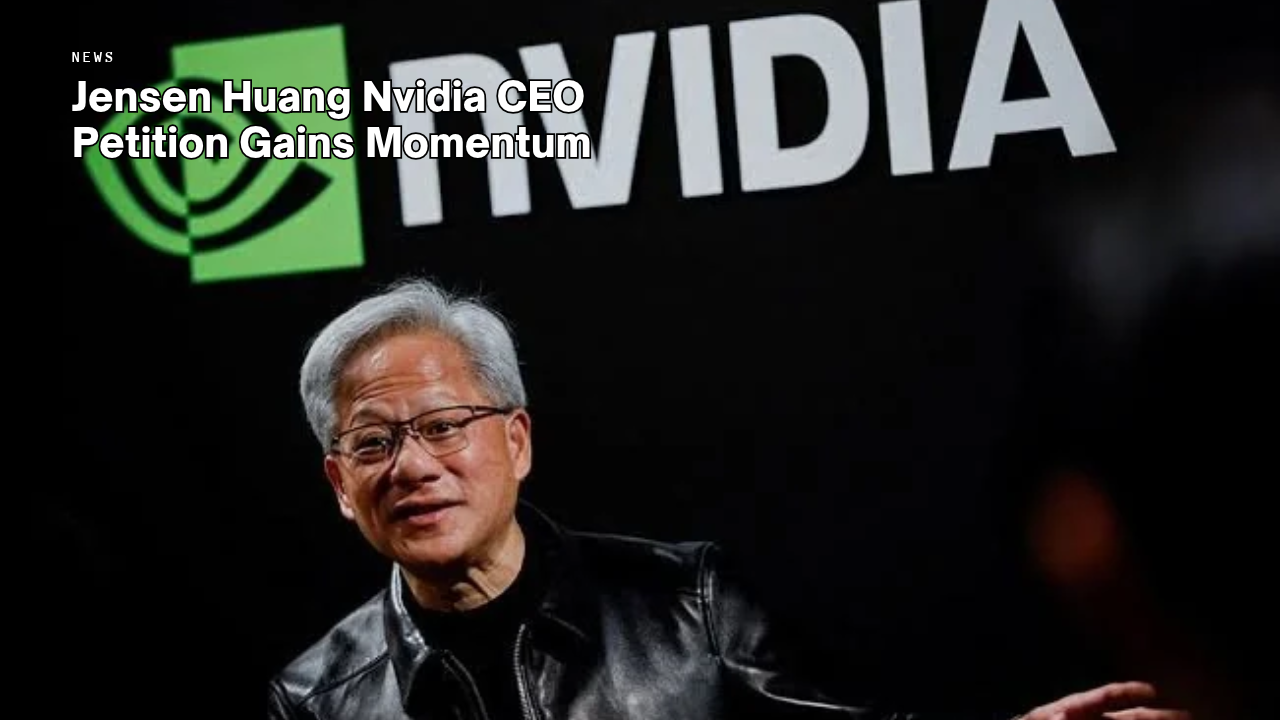
A recent petition advocating for the reinstatement of Jensen Huang as Nvidia’s CEO has rapidly gained traction, creating a significant buzz across the technology and business sectors in 2026. This burgeoning movement follows earlier reports of discussions within Nvidia’s board regarding potential changes in leadership, a situation that had many investors and industry observers holding their breath. Now, it appears a strong contingent of stakeholders is making their voices heard, firmly backing Huang’s continued tenure at the helm of the AI chip giant.
The petition’s momentum underscores the deep respect and perceived indispensability of Huang, particularly given Nvidia’s pivotal role in the ongoing artificial intelligence revolution. As we navigate a year where technological advancements continue to redefine industries, understanding the dynamics of this Business Insider reported story offers crucial insight into corporate governance, shareholder influence, and the critical importance of visionary leadership in high-stakes industries.
Key Takeaways
- A petition for Jensen Huang’s reinstatement as Nvidia CEO is gaining significant momentum among stakeholders.
- This movement emerged after Nvidia’s board reportedly discussed potential leadership changes.
- Huang is widely seen as indispensable to Nvidia’s continued dominance in the AI and GPU markets.
- The situation highlights the complex interplay between corporate boards, shareholder sentiment, and executive leadership.
- The outcome could significantly impact Nvidia’s strategic direction and its stock performance in the coming years.
Table of Contents
- The Unfolding Drama: A Petition for Jensen Huang’s Return
- Why Jensen Huang Matters to Nvidia’s Trajectory
- The Context of Leadership Discussions: What Triggered the Change?
- The Voice of the Shareholders and Employees: Fueling the Reinstatement Bid
- What Does a CEO Reinstatement Signal for Nvidia and the Industry?
- Navigating the Future: Corporate Governance and Shareholder Power
- Frequently Asked Questions
- Sources
The Unfolding Drama: A Petition for Jensen Huang’s Return
The online petition to reinstate Jensen Huang as the chief executive of Nvidia is seeing a significant surge in support, reflecting a passionate stance from a segment of the company’s ecosystem. This collective effort comes on the heels of reports that Nvidia’s board had been weighing strategic leadership changes. While the specifics of those board discussions remained private, the very notion of removing the co-founder and long-time CEO ignited a strong reaction from those who credit him with Nvidia’s unparalleled success.
This situation is a fascinating evolution from our earlier report, Nvidia Board Weighs Ousting of CEO Jensen Huang, where the focus was purely on the internal deliberations. Now, the narrative has shifted to a powerful external pushback. It demonstrates a profound belief in Huang’s vision, particularly his early and aggressive pivot towards AI, which has transformed Nvidia into one of the most valuable technology companies globally.
The petition, circulating on various digital platforms, seeks to influence the board’s decision, emphasizing Huang’s irreplaceable role. Supporters argue that any change at the top, especially now, would destabilize the company’s strategic direction and potentially jeopardize its leadership in the intensely competitive AI chip market. We’re talking about billions, if not trillions, of dollars in market capitalization at stake.
Why Jensen Huang Matters to Nvidia’s Trajectory
Jensen Huang is not just a CEO; he is the visionary co-founder who steered Nvidia from a fledgling graphics chip startup in 1993 to a global technology powerhouse in 2026. His leadership has been characterized by audacious bets on emerging technologies, most notably the strategic pivot towards parallel computing with GPUs, which laid the groundwork for the modern AI revolution. Nvidia’s current market dominance in AI, data centers, and specialized computing is a direct result of his foresight and sustained commitment.
Under Huang’s guidance, Nvidia didn’t just adapt to market changes; it actively created them. Consider the company’s Hopper H100 GPU, for example. This single product line is central to nearly every major AI development, from large language models to advanced scientific research. Its unparalleled performance and ecosystem have made it indispensable for companies like OpenAI, Google, and Meta, generating unprecedented revenue for Nvidia.
Beyond hardware, Huang has cultivated an entire software ecosystem, CUDA, that locks developers into Nvidia’s platform. This vertically integrated strategy, combining leading-edge hardware with robust software, creates a formidable competitive moat that few, if any, rivals can replicate. It’s this deep entanglement in the fabric of AI infrastructure that makes Huang’s leadership perceived as so vital, particularly by those who understand the intricate dependencies of the technology business.
The Context of Leadership Discussions: What Triggered the Change?
Understanding the current reinstatement efforts requires a look back at the initial discussions concerning Jensen Huang’s leadership. While the precise details of Nvidia’s board deliberations remain confidential, reports suggested that internal discussions centered around various strategic considerations. These could have included topics like long-term succession planning, adapting to an evolving competitive landscape, or perhaps even diversifying Nvidia’s strategic focus beyond its core strengths.
In high-growth, high-stakes sectors like technology, boards frequently evaluate leadership as part of their fiduciary duty to shareholders. This is not uncommon, even for highly successful founders. Companies often reach inflection points where fresh perspectives are considered, or where the board seeks to future-proof the organization against potential challenges. For a company as monumental as Nvidia, with its staggering market valuation, these conversations would naturally carry immense weight and sensitivity.
However, the rapid and widespread support for Huang’s reinstatement, as evidenced by this petition, suggests that many stakeholders believe the timing or the premise of such a change is ill-advised. They likely see any move away from Huang as a direct threat to the very qualities that have propelled Nvidia to its current zenith.
The Voice of the Shareholders and Employees: Fueling the Reinstatement Bid
The momentum behind the Jensen Huang reinstatement petition isn’t just a whisper in the wind; it’s a growing chorus. While specifics about who initiated the petition are not always publicly detailed, these movements typically draw significant support from a diverse group of stakeholders. This includes long-term shareholders who have seen their investments multiply under Huang’s leadership, as well as current and former employees who credit his vision for fostering a dynamic and innovative work environment.
Industry analysts and technology observers are also weighing in, often expressing concern over the potential disruption any CEO change could bring. The sentiment is clear: in a market as volatile and fast-moving as AI, stability at the top, especially from a proven leader, is invaluable. This collective voice aims to send a clear message to Nvidia’s board of directors: the current leadership is not just performing, but is seen as essential for continued market leadership.
This isn’t an isolated incident in the tech world. We’ve seen similar public pushes and boardroom dramas play out with other prominent tech figures. However, the intensity here reflects Nvidia’s unique position as a foundational layer for the global AI infrastructure. The passion from this petition stems from a belief that a change at the top could have ripple effects far beyond Nvidia itself, potentially impacting the pace of AI innovation across numerous industries.
What Does a CEO Reinstatement Signal for Nvidia and the Industry?
Should the petition to reinstate Jensen Huang successfully sway Nvidia’s board, the implications would be substantial. For Nvidia itself, it would likely be seen as a reaffirmation of current strategy and a vote of confidence in Huang’s ongoing leadership. We would probably see a stabilization, and possibly a surge, in investor confidence and the company’s stock price, as uncertainty around leadership is often a market dampener.
Beyond the immediate financial impact, a reinstatement would send a powerful message about the value of founder-led companies in the tech sector. It would underscore the idea that a visionary founder, especially one with a proven track record, can sometimes be irreplaceable, particularly when their company is at the vanguard of a technological paradigm shift like AI. Consider the broader market for AI innovations, such as those discussed in Anthropic IPO and What It Means for Investors; leadership stability at key players like Nvidia directly influences the health and growth potential of the entire ecosystem.
Conversely, a failure of the petition could signal the board’s commitment to a new strategic direction, regardless of public sentiment. This would then shift focus to the chosen successor and their vision for navigating Nvidia’s future. Either outcome would undoubtedly reverberate throughout the technology business landscape, influencing corporate governance discussions and investor relations for years to come.
Navigating the Future: Corporate Governance and Shareholder Power
The phenomenon of a petition for CEO reinstatement brings into sharp focus the intricate relationship between a company’s board of directors, its executive leadership, and the power of its shareholders. While petitions can generate significant public and investor pressure, the ultimate legal authority for appointing or removing a CEO typically rests with the board. Boards are mandated to act in the best long-term interest of the company and its shareholders, which sometimes requires tough decisions, even if unpopular.
This situation presents a classic governance challenge. On one hand, you have a highly successful founder whose vision has driven unparalleled growth. On the other, a board tasked with rigorous oversight and strategic planning for the future, which might include considering succession plans or new directions. The trade-off here is clear: while public sentiment can provide a powerful signal, it doesn’t automatically override the board’s legal and fiduciary responsibilities.
In 2026, as technology companies command ever-larger portions of global market capitalization, the scrutiny on corporate governance is more intense than ever. The Nvidia situation serves as a compelling case study on how shareholder activism and public opinion can influence, though not necessarily dictate, the decisions made in the boardrooms of the world’s most influential companies. It highlights a critical balance that every major corporation must strike to maintain stability while evolving strategically.
Frequently Asked Questions
What is the Jensen Huang Nvidia CEO petition about?
The Jensen Huang Nvidia CEO petition is an online movement gaining momentum that calls for the reinstatement of Jensen Huang as the chief executive of Nvidia. It was launched in response to recent reports indicating that Nvidia’s board of directors had been discussing potential changes in the company’s leadership.
Who started the Jensen Huang reinstatement petition?
While the specific originators of the petition are not widely publicized, such movements typically gather support from a broad coalition of stakeholders. This includes loyal investors, current and former employees, and industry enthusiasts who deeply value Jensen Huang’s leadership and strategic vision for Nvidia.
Why is Jensen Huang considered critical to Nvidia?
Jensen Huang is considered critical because he co-founded Nvidia and has led it for over three decades, transforming it into a leader in GPU and AI technology. His strategic foresight, particularly in betting on AI, has been instrumental in the company’s success and its dominant position in the crucial AI chip market.
What happens if the petition succeeds in its goal?
If the petition successfully sways Nvidia’s board, it would likely mean Jensen Huang retains his position as CEO. This outcome would probably stabilize investor confidence, reinforce Nvidia’s current strategic direction, and signal a strong affirmation of founder-led executive leadership within the technology sector.
What are the risks associated with this leadership uncertainty at Nvidia?
Leadership uncertainty, regardless of the outcome, can introduce volatility. Risks include potential impacts on Nvidia’s stock price, concerns about long-term strategic planning, and possible internal disruptions. Prolonged discussions or an unexpected change could temporarily unsettle investors and employees.
Does a petition truly influence corporate board decisions?
While petitions do not legally bind a corporate board, they can exert significant public and shareholder pressure. They serve as a strong indicator of sentiment among key stakeholders, which boards typically consider carefully. However, the final decision rests with the board’s fiduciary responsibilities.
The ongoing narrative surrounding Jensen Huang and Nvidia’s leadership is a stark reminder of the immense influence a single visionary can have on a global technology giant. As the petition for his reinstatement continues to gather steam, the eyes of the business and tech world remain fixed on Nvidia, watching how this delicate balance of corporate governance, market sentiment, and founder loyalty ultimately plays out in 2026. This is more than just a personnel discussion; it’s a testament to the high stakes involved in guiding the companies that are literally building our future.
Sources
- Business Insider, Petition to Reinstate Jensen Huang as Nvidia CEO Gains Momentum Amid Leadership Discussions
- Nvidia, Hopper H100 GPU Product Information

TRENDING: Highly Classified US National Security Communications Network Goes Down
Download the new game Guess The Celebrity Quiz and check how well you know your idols
Always be up to date with the news and follow the trends!
👉🏻 Support our work by giving us a small donation